
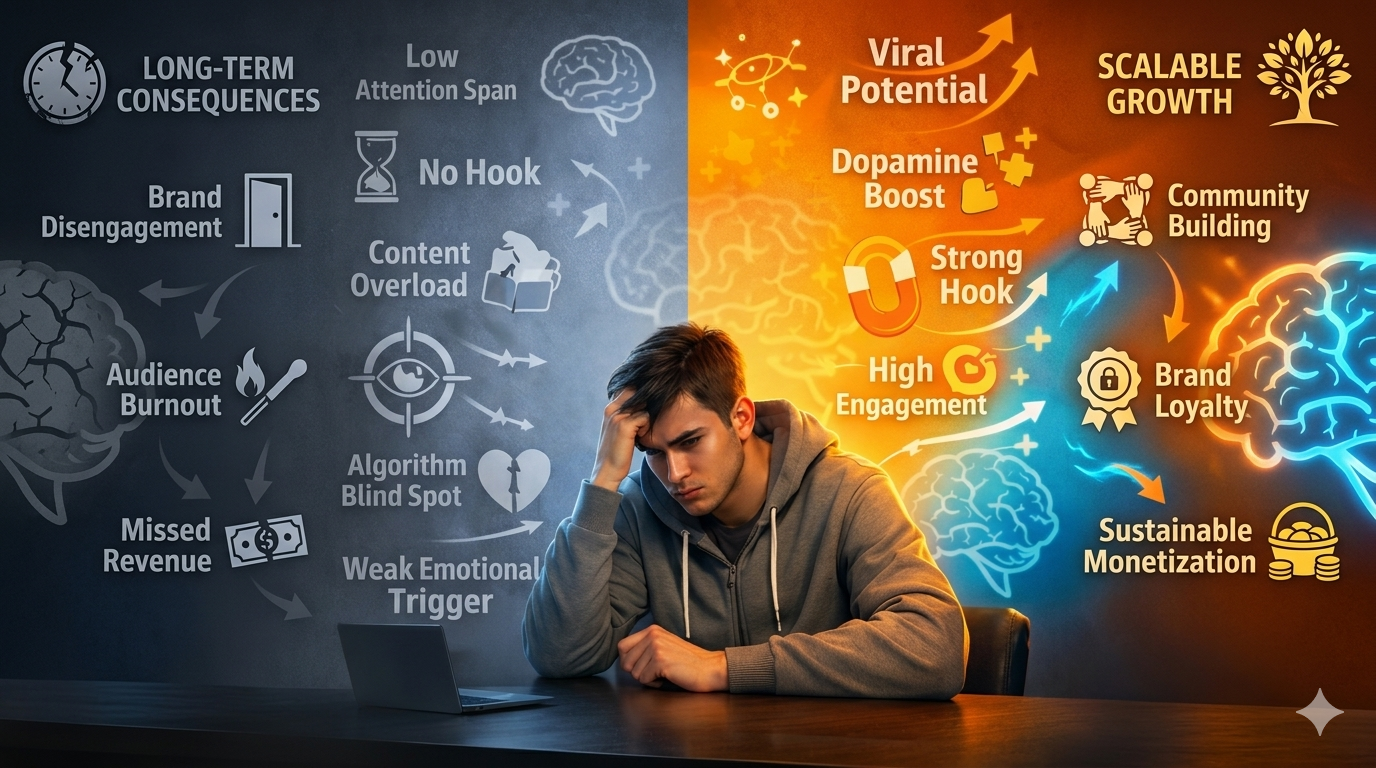
In the current digital landscape, the battle for a consumer’s focus is no longer fought with simple advertisements or catchy jingles; it is a sophisticated war of attrition waged within the neural pathways of the human brain. Most modern brands struggle to understand why their engagement metrics fluctuate or why a once-loyal audience suddenly migrates to a competitor’s platform.
This disconnect often stems from a fundamental misunderstanding of the neurological mechanisms that dictate how people interact with digital interfaces. To truly command a market, one must look past the surface-level metrics of clicks and likes to understand the social media triggers that facilitate deep-seated habits and long-term digital patterns.
Understanding these psychological catalysts is essential because they represent the “invisible hand” of modern commerce. When a user reaches for their phone upon waking or finds themselves scrolling through a feed for hours, they are not necessarily making a conscious choice. Instead, they are responding to carefully engineered stimuli designed to elicit specific emotional and chemical responses.
By deconstructing these social media triggers, businesses can move away from manipulative tactics and toward a strategy of genuine value and ethical engagement. This guide serves as a comprehensive masterclass in the intersection of technology and human nature, providing the insights necessary to build a sustainable digital presence that respects the user while achieving commercial objectives.
What Are Social Media Triggers and Why Do They Exist?
To grasp the complexity of modern digital interaction, we must first define what a trigger actually is in a technical sense. A trigger is a functional cue that prompts an immediate action. In the realm of the internet, these cues are often categorised into two types: external and internal. External triggers are the notifications, pings, and red dots that alert us to new information. Internal triggers, however, are the emotional states—such as boredom, loneliness, or anxiety—that lead a user to seek out a digital solution. The most potent social media triggers are those that successfully bridge the gap between an external alert and an internal emotional need.
The existence of these mechanisms is not accidental. As platforms compete for a finite amount of human attention, they have turned to social psychology to refine their interfaces. This is often referred to as “persuasive design.” The goal is to create a frictionless loop where the user receives a variable reward in exchange for their time. This cycle is rooted in our evolutionary history; as social creatures, we are hardwired to seek status, belonging, and information. Modern platforms simply digitise these ancient biological urges.
For a business, understanding this foundation is the first step toward better content marketing. If you understand that a customer is looking for a sense of achievement or social validation, you can tailor your messaging to provide those feelings through your products or services. Rather than just pushing for a sale, you become a provider of the emotional reward the user is subconsciously seeking. This shift in perspective is what separates a standard marketer from a true strategist.
The Role of Dopamine in Social Media Triggers
One cannot discuss digital interaction without addressing the role of dopamine, the neurotransmitter often mislabelled as the “pleasure chemical.” In reality, dopamine is the chemical of anticipation and craving. It is released when we expect a reward, driving us to perform the actions necessary to obtain it. This is the engine behind most social media triggers. When a user sees a notification icon, their brain releases dopamine in anticipation of what that notification might be, a like, a comment, or a message from a friend.
The most effective platforms utilise what is known as a “variable ratio schedule of reinforcement.” This is the same logic that makes slot machines so addictive. If a reward is guaranteed every time, it becomes predictable and eventually boring. However, if the reward is unpredictable, meaning you don’t know if the next scroll will reveal a hilarious video or a boring advertisement, the brain remains in a constant state of high-alert anticipation. This keeps the user engaged for much longer periods than they originally intended.
Businesses must be aware of this cycle to avoid contributing to harmful digital addiction. While it is tempting to use these tactics to boost short-term numbers, the long-term effect is often “user burnout.” A customer who feels manipulated or exhausted by a brand’s digital presence will eventually develop a negative association with that brand. Instead, the focus should be on creating high-quality, meaningful interactions that provide a sense of genuine satisfaction rather than just a fleeting dopamine spike. Professional branding involves creating an identity that people trust, not just one they are compelled to click on.
Exploring User Behaviour and the Habit Loop
To influence user behaviour effectively, we must understand the “Habit Loop,” a concept popularised by researchers like Charles Duhigg. The loop consists of three parts: the cue, the routine, and the reward. In the digital world, the cue is often one of many social media triggers, the routine is the act of opening an app or clicking a link, and the reward is the content consumed or the social interaction gained.
Over time, this loop becomes so ingrained that the brain no longer needs to make a conscious decision. This is how “phantom vibration syndrome” occurs, where people feel their phone vibrating even when it isn’t. They have become so attuned to the cue that their brain simulates it. For a brand, the ultimate goal is to become a positive part of a customer’s routine. This is achieved not through trickery, but through consistent, high-value digital marketing that solves problems or provides legitimate entertainment.
When analysing how your audience moves through your website or social pages, it is helpful to use tools like Google Search Central to understand what queries are bringing them to you. Are they looking for information during a moment of curiosity? Are they looking for a product during a moment of need? By aligning your content with these specific cues, you can enter the habit loop in a way that feels natural and helpful rather than intrusive. This is the cornerstone of effective content marketing.
The Ethics of Attention Hacking and Consumer Influence
The term attention hacking refers to the use of psychological vulnerabilities to keep users tethered to a screen. This includes features like “infinite scroll,” which removes the natural stopping points that would usually tell our brains to move on to another task. By eliminating these “stopping cues,” platforms can significantly increase the time spent on site. While this might look good on an analytics dashboard, it raises significant ethical questions for the modern business.
As a content strategist, you must decide where the line is between persuasion and manipulation. Consumer influence is a powerful tool, but it comes with a responsibility to the well-being of the audience. Ethical marketing focuses on “Time Well Spent”, a movement that encourages designers to create interfaces that help people live their lives rather than distracting them from it. When you build a website using professional website design, you should aim for a user experience that is intuitive and efficient, allowing the user to find what they need without unnecessary friction or manipulative distractions.
According to research from HubSpot, consumers are increasingly gravitating toward brands that demonstrate transparency and social responsibility. By rejecting the more aggressive forms of attention hacking, you actually build a stronger, more resilient brand. Customers who feel respected are more likely to become brand advocates. This is why a holistic digital growth partner will always advocate for strategies that prioritise long-term trust over short-term “hacks.”
Social Psychology: The Power of Social Proof and Scarcity
Our digital interactions are heavily influenced by the principles of social psychology. Two of the most prominent principles are social proof and scarcity. Social proof is the tendency of individuals to look to others to determine correct behaviour. This is why “likes,” “shares,” and “follower counts” are such powerful social media triggers. They signal to a new visitor that the content is valuable and that the brand is trustworthy.
Scarcity, on the other hand, is the fear of missing out (FOMO). When we perceive that an opportunity is limited, our desire for it increases. This is why “limited time offers” or “only 2 items left in stock” are so effective at driving immediate action. However, these tactics must be used with integrity. False scarcity, where a “sale” never actually ends, is a quick way to lose customer trust. Authentic scarcity, combined with genuine social proof, creates a compelling reason for a customer to engage.
To implement these ideas effectively, businesses should look toward SEO services that focus on building authority and reputation. High rankings on search engines are a form of social proof in themselves; they suggest that a site is a credible source of information. Integrating testimonials, case studies, and user-generated content into your site can further strengthen this psychological foundation. For deeper insights into how search engines evaluate authority, resources like Moz provide invaluable guidance on building “Domain Authority.”
Technical Foundations: Page Experience and User Retention
While psychology is the “why” behind user interaction, the “how” is often technical. A slow-loading website or a clunky mobile interface can act as a negative trigger, causing a user to abandon their journey before it has even begun. This is why Google Page Experience documentation emphasises core web vitals like loading speed, interactivity, and visual stability. If the technical foundation is weak, even the most psychologically astute content will fail to convert.
High-quality website design ensures that the user’s path to information is as smooth as possible. When a user experiences “friction”, such as a pop-up that is hard to close or a link that doesn’t work, it breaks the flow of engagement and triggers a frustration response. This negative experience can be more memorable than any positive content you provide. Therefore, optimising for technical performance is a prerequisite for any strategy involving social media triggers.
Utilising technical SEO tools like Screaming Frog can help you identify these friction points across your site. By fixing broken links and ensuring a logical site architecture, you support the user’s psychological need for order and ease. A well-structured site allows the user to stay in a “flow state,” where they are deeply engaged with your content and more receptive to your brand’s message. This technical diligence is a core component of the digital marketing services provided by experts who understand the intersection of tech and human behaviour.
How Digital Junkieee Helps Businesses Achieve Social Media Triggers
Navigating the complex landscape of psychological triggers and digital ethics requires a partner who understands both the art and the science of engagement. Digital Junkieee operates as a comprehensive digital growth partner, helping brands translate deep psychological insights into actionable strategies. Whether you are looking to refine your SEO services or overhaul your entire brand identity, our team focuses on creating meaningful connections with your target audience.
We believe that the best way to utilise social media triggers is to provide consistent, undeniable value. This starts with a robust content marketing strategy that addresses the real needs and pain points of your customers. By creating high-quality, authoritative articles, much like this one, we help you build a community of educated and engaged followers. Our approach to branding ensures that every touchpoint a customer has with your business reinforces a message of quality and reliability.
Furthermore, our expertise in website design ensures that your digital home is optimised for both search engines and human users. We eliminate the technical friction that often sabotages engagement, allowing your message to shine. If you are ready to move beyond basic tactics and build a sophisticated digital system, we invite you to explore our services or contact us today. Let Digital Junkieee help you master the psychological and technical nuances of the modern marketplace to achieve sustainable growth.
FAQ Section
What is the primary role of social media triggers in a modern digital marketing strategy?
The role of these triggers is to facilitate a transition from passive viewing to active engagement. In an environment saturated with information, a brand cannot rely on the customer to find them; they must create cues that draw the customer in. By understanding the psychological underpinnings of social media triggers, a business can create content that resonates with the audience’s current emotional state. This allows for the creation of more personalised and effective campaigns. However, it is vital to use these triggers to lead the user toward a beneficial outcome, such as solving a problem or acquiring a new skill, rather than simply maximizing time on site for its own sake.
How can small businesses implement social media triggers without being manipulative?
Ethical implementation focuses on “utility” over “distraction.” A small business can use triggers to remind a customer of a scheduled appointment, offer a genuine discount on a product they’ve shown interest in, or provide a link to a helpful educational resource. The key is transparency and value. If the trigger helps the user achieve their own goals, it is a service. If the trigger only serves the business’s goals at the expense of the user’s time or mental health, it risks being manipulative. By focusing on high-quality branding and clear communication, small businesses can build long-term loyalty that far outlasts the effects of any psychological “hack.”
What tools are most effective for identifying and improving social media triggers?
To identify how triggers are performing, businesses should look to comprehensive analytics suites. Google Search Central provides data on what content is successfully capturing interest from search results. Heatmapping tools can show where users are clicking and where they are losing interest on a page. For a deeper technical audit, Ahrefs or SEMrush can help you understand the competitive landscape and identify what triggers your competitors are using successfully. Additionally, performing a site crawl with Screaming Frog ensures that your technical triggers—like internal links and call-to-action buttons—are functioning perfectly across all devices.
How does understanding social psychology improve user retention?
Retention is the result of a positive habit loop. When a user understands that interacting with your brand consistently results in a positive reward, whether that is feeling more informed, more entertained, or more efficient, they are likely to return. Principles of social psychology, such as the “Endowed Progress Effect” (where people are more likely to complete a task if they feel they have already made progress), can be used to keep users engaged. For example, a “getting started” checklist on a website can give users a sense of achievement that encourages them to continue. By designing for the human brain’s natural desire for closure and competence, you build a much more loyal audience.
Can social media triggers be used to combat digital addiction?
Ironically, the same mechanisms that contribute to overuse can be repurposed to promote healthier digital habits. Features like “usage timers” or “do not disturb” modes are essentially “reverse triggers” designed to prompt the user to disengage. A brand that prioritises the mental well-being of its audience might include “stopping cues” in its content, such as suggesting the reader take a break after a long article. This builds a unique form of “ethical authority.” When a business demonstrates that it cares more about the customer’s well-being than just their clicks, it creates a powerful emotional bond. Utilising SEO services to promote “slow content” or deep-dive resources is one way to encourage more mindful consumption.
Conclusion
The evolution of the digital marketplace has transformed the relationship between brands and consumers into a complex interplay of biology, technology, and ethics. Throughout this guide, we have explored how social media triggers function as the primary drivers of engagement in an increasingly distracted world. By understanding the chemical influence of dopamine, the structural power of the habit loop, and the ethical considerations of attention hacking, businesses can move toward a more sophisticated and respectful form of marketing. The goal should never be to control the customer’s mind, but rather to understand it well enough to provide genuine value in the moments when it is needed most.
As we have seen, the most successful digital strategies are those that combine deep psychological insights with impeccable technical execution. Whether you are improving your content marketing or refining your website design, the focus must remain on building trust and providing utility. Digital Junkieee is dedicated to helping businesses navigate these challenges, ensuring that your digital presence is both effective and ethical. By applying the principles discussed today, you can build a brand that doesn’t just capture attention but earns it. We encourage you to continue your journey by exploring our blog or reaching out for a consultation to see how we can support your long-term growth.
0 Comments