
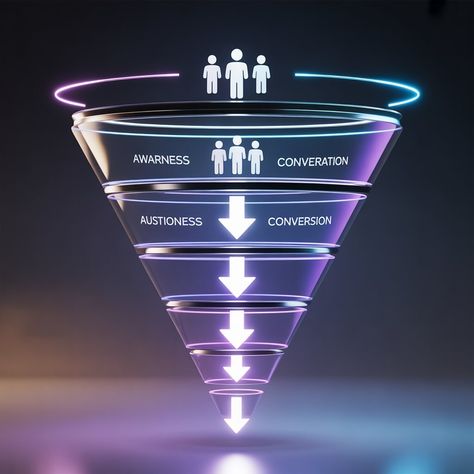
Understanding the mechanics of modern customer acquisition requires shifting from viewing transactions as isolated events to viewing them as a fluid journey. A common hurdle for many digital ventures is the “leaky bucket” syndrome, where significant resources are poured into generating traffic, yet the actual results remain stagnant.This usually happens because the journey’s underlying architecture is fragmented or misunderstood. To rectify this, one must master the specific Funnel Stages that guide a stranger from initial curiosity to becoming a loyal advocate.
This guide is designed to serve as a comprehensive educational resource for those who are ready to move beyond surface-level tactics. We will explore how a well-structured Sales Funnel functions not just as a marketing tool, but as a sophisticated system for building trust and delivering value at scale. By the end of this article, you will understand how Funnel Optimisation and strategic Lead Conversion techniques can fundamentally alter your business trajectory. Whether you are refining an existing process or building from scratch, these insights into Conversion Rates will provide the clarity needed to achieve sustainable digital growth.
What Are Funnel Stages and Why Do They Matter?
To truly grasp the concept of Funnel Stages, one must first envision the customer journey as a psychological progression. It is the visual and strategic representation of the path a prospect takes, starting from the moment they become aware of your brand until the moment they complete a desired action. In a professional context, these stages act as a roadmap for content delivery, ensuring that the right message reaches the right person at the exact right time. Without this structure, marketing efforts often feel disjointed, leading to a poor user experience and diminished returns on investment.
The importance of these stages in a modern digital strategy cannot be overstated. We live in an era of information saturation where consumers are increasingly cynical about traditional advertising. A structured journey allows a business to provide education and solve problems before ever asking for a sale. This pedagogical approach to marketing is what differentiates high-growth companies from those that struggle to gain traction. By segmenting the journey, you gain the ability to measure performance with surgical precision, identifying exactly where prospects are dropping off and which specific touchpoints require refinement.
When we talk about conversion rates, we are essentially measuring the efficacy of these individual transitions. It is a common misconception that there is only one “conversion” at the end of the journey. In reality, a healthy system is composed of multiple micro-conversions. For instance, moving a visitor from a blog post to a newsletter signup is a vital conversion in itself. By focusing on the health of every stage, you create a robust ecosystem that naturally filters and nurtures the most qualified prospects, leading to more predictable and scalable revenue.
Stage 1: The Awareness Phase – Capturing Interest
The first of the funnel stages is focused entirely on discovery. At this point, the prospect may not even be aware that your specific solution exists; they are often simply searching for answers to a problem or looking to satisfy a curiosity. The goal here is not to sell, but to attract. This is where high-quality content marketing and SEO become your most valuable assets. By creating educational resources that address the pain points of your target audience, you position your brand as a helpful authority rather than a persistent salesperson.
During the awareness phase, the focus should be on broad-reach channels. This includes informative blog posts, social media engagement, and educational videos. It is essential to understand that the metrics for success here are engagement and reach rather than immediate sales. According to Google Search Central, providing helpful, reliable, and people-first content is the primary driver for organic visibility. If your top-of-funnel content provides genuine value, users are much more likely to remember your brand when they move into the deeper funnel Stages.
Effective awareness requires a deep understanding of your audience’s intent. Are they looking for a quick fix, or are they seeking a long-term partner? By aligning your content with these different intents, you can build a diverse entry point for your sales funnel. This is also the stage where Branding plays a pivotal role; the visual and tonal consistency of your message creates the first impression that will either invite further exploration or cause a bounce.
Stage 2: The Interest and Consideration Phase
Once a prospect has moved past the initial discovery, they enter the interest and consideration stage. Here, the relationship shifts from casual observation to active evaluation. The user is now aware of their problem and is actively comparing different solutions. To maintain their attention, you must provide deeper, more technical, or more specific information that highlights your unique value proposition without being overly “salesy.”
In this phase, lead magnets such as whitepapers, webinars, and detailed case studies are exceptionally effective. You are looking to exchange high-value information for the prospect’s contact details, which is a critical step in lead Conversion. By securing an email address, you move the relationship from a public platform to a more private, direct channel. This allows for a more personalised nurturing sequence that can address specific objections or provide deeper insights into how your services function.
It is during this transition that the quality of your digital infrastructure becomes apparent. A poorly designed website can create friction that kills interest instantly. Ensuring that your Website Design is intuitive and fast is non-negotiable. As highlighted by HubSpot, the consideration stage is often where the “educational” aspect of your funnel must peak. You are essentially teaching the prospect how to be a better consumer of your particular type of service or product.
Stage 3: The Evaluation Phase – Building Trust
The evaluation phase is perhaps the most delicate of the funnel Stages. The prospect is now narrowed down to a few options, and they are looking for reasons to choose—or reject—you. This is the time to leverage social proof, testimonials, and detailed product demonstrations. You need to prove that your solution not only works in theory but has worked in practice for people just like them.
Trust is the primary currency here. To build it, you must be transparent about what your solution can and cannot do. This honesty actually increases your conversion Rates in the long run by ensuring that you only attract customers who are a perfect fit. If you are a service provider, offering a Digital Marketing audit or a free consultation can be the final piece of evidence a prospect needs to feel confident in their decision.
Furthermore, technical authority is vital. Linking to external research or using tools like Moz to validate your SEO claims can provide the third-party validation that many high-level decision-makers require. The goal is to remove all perceived risk from the transaction. When the prospect feels that the benefit of your solution far outweighs the risk of the investment, they are ready to move to the next stage of the funnel.
Stage 4: The Intent and Decision Phase
At the intent stage, the prospect has decided that they want to move forward, but they may still be hesitating on the “when” or the “how.” They might have items in a shopping cart or be reviewing a contract. Your task now is to provide a clear, frictionless path to completion. This often involves offering incentives such as limited-time discounts, money-back guarantees, or bonuses that provide immediate value.
This is where funnel Optimisation is most visible. Every extra click, every slow-loading page, and every unnecessary form field is a potential point of abandonment. You must audit your checkout or sign-up process with extreme scrutiny. Referencing Google Page Experience guidelines is helpful here, as site speed and mobile responsiveness are directly tied to the final decision-making process.
To facilitate a smooth transition, ensure that your Contact information and support channels are easily accessible. Sometimes, a simple question about a warranty or a technical specification is all that stands between a prospect and a completed sale. Providing instant answers through live chat or a comprehensive SEO Services FAQ page can significantly shorten the decision cycle.
Stage 5: The Purchase or Action Phase
The purchase phase is the culmination of your efforts in the preceding Funnel Stages, but it is not the end of the journey. This is where the actual transaction occurs. While it may seem like the work is done, the way you handle the transaction sets the tone for the entire future relationship. The process must be secure, professional, and celebratory.
Confirmation emails should be sent immediately, providing clear instructions on what happens next. If you are selling a service, such as Content Marketing, this is the onboarding phase. You are moving from the role of a “seller” to the role of a “partner.” This transition is critical for long-term retention.
As noted by Ahrefs, the data gathered during this stage is invaluable for future funnel Optimisation. By analysing which sources led to the most high-value purchases, you can reallocate your budget to the most effective awareness and interest channels. This data-driven approach ensures that your sales Funnel becomes more efficient over time, rather than relying on guesswork.
Stage 6: The Retention Phase – Keeping the Momentum
It is far more cost-effective to retain an existing customer than it is to acquire a new one. Therefore, the retention phase is one of the most important Funnel Stages for long-term profitability. After the initial purchase, your focus must shift to ensuring the customer achieves the results they were promised. This involves proactive support, regular updates, and ongoing education.
A customer who feels supported is much more likely to return for future purchases. You can use email automation to send “how-to” guides, feature updates, or industry news that keeps your brand top-of-mind. This continuous value delivery reinforces the idea that your business is a long-term resource.
For businesses focusing on Digital Growth, the retention stage is an opportunity to cross-sell or up-sell related services. If a client has seen success with their web design, they may now be interested in advanced SEO strategies to drive more traffic. This natural progression increases the lifetime value of each customer and stabilises your revenue streams.
Stage 7: The Advocacy Phase – Turning Customers into Promoters
The final stage of the funnel is advocacy. This occurs when a customer is so satisfied with their experience that they begin to actively recommend your brand to others. This “word-of-mouth” marketing is the most powerful form of social proof available, as it carries the weight of a personal recommendation.
To encourage advocacy, you can implement referral programmes, ask for reviews, or invite your best customers to participate in case studies. These advocates essentially become an extension of your marketing team, feeding new prospects back into the “Awareness” stage of your funnel. This creates a self-sustaining cycle of growth.
According to Neil Patel, leveraging user-generated content and testimonials can boost your conversion Rates across the entire funnel. When new prospects see real people achieving real results, their scepticism melts away. By investing in the advocacy stage, you turn your customer base into a community, which is the ultimate competitive advantage in any industry.
Common Mistakes in Funnel Construction
Even with a solid understanding of funnel Stages, many businesses fall into avoidable traps. One of the most common errors is “funnel friction”, creating too many steps or asking for too much information too early. If your awareness-stage blog post requires a 10-field form to read, you will lose the majority of your audience before they ever get a chance to learn from you.
Another frequent mistake is neglecting the post-purchase experience. Many organisations focus all their energy on the “sale” and then effectively abandon the customer. This leads to high churn and a negative reputation. Remember that your sales Funnel should be a continuous loop, not a straight line that ends at a transaction.
Finally, failing to use data for funnel Optimisation is a significant oversight. Every stage of your funnel should be tracked with analytics. If you see a massive drop-off between the “Interest” and “Evaluation” stages, that is a clear signal that your middle-of-funnel content isn’t building enough trust or addressing the right objections. Use tools like Search Engine Journal to stay updated on the latest tracking and analytics best practices.
How Digital Junkieee Helps Businesses Achieve Funnel Optimisation
At Digital Junkieee, we understand that building a high-converting system requires a blend of creative strategy and technical precision. We don’t just look at isolated metrics; we look at the holistic journey of your customers through the various funnel Stages. Our team of experts is dedicated to helping you identify gaps in your current strategy and implementing robust solutions that drive measurable growth.
Our comprehensive suite of Services is designed to support you at every turn. From crafting authority-building content that fuels the awareness stage to designing high-performance landing pages that skyrocket your lead Conversion, we provide the tools and expertise needed for modern success. We believe that digital growth is the result of a well-oiled machine, and we are here to help you build and maintain that machine.
Whether you need advanced SEO Services to attract more prospects or a complete Website Design overhaul to improve user experience, Digital Junkieee is your strategic partner. We take an educational approach, working closely with our clients to ensure they understand the “why” behind every tactic. Our goal is to empower your business to achieve sustainable, long-term success through expert funnel Optimisation and strategic brand development.
FAQ Section
What is the role of Funnel Stages in digital marketing?
The role of funnel Stages is to provide a structured framework for managing the customer journey. By breaking down the path to purchase into distinct phases, Awareness, Interest, Consideration, Intent, Evaluation, Purchase, and Advocacy, marketers can tailor their messaging to the specific needs and psychological state of the prospect at any given time. This segmentation allows for more efficient resource allocation, as you can identify which areas of your strategy are performing well and which require further funnel Optimisation. Without these stages, marketing efforts often become scattergun and ineffective, failing to build the necessary trust required for high-value transactions in a competitive digital landscape.
How can small businesses implement Funnel Stages effectively?
Small businesses can implement funnel Stages by starting with a simple, three-step model: Top of Funnel (Awareness), Middle of Funnel (Consideration), and Bottom of Funnel (Decision). The key is to focus on quality over quantity. Instead of trying to be on every social media platform, a small business should create one or two pieces of truly exceptional educational content that address a primary customer pain point. This attracts the right audience. From there, a simple email sign-up can facilitate lead Conversion, allowing the business to nurture those leads with helpful advice and offers. Success in the early stages is often about consistency and genuine helpfulness rather than having a massive marketing budget.
What tools help improve Funnel Optimisation?
Improving funnel Optimisation requires a combination of analytical and functional tools. For tracking and data analysis, Google Analytics and Search Console are essential for understanding how users move through your site. For the awareness stage, SEO tools like Ahrefs or Screaming Frog help you identify keywords and technical issues. For lead nurturing and conversion, CRM and email marketing platforms like HubSpot or Mailchimp allow for automated, personalised communication. Additionally, heatmapping tools like Hotjar can show you exactly where users are clicking—or getting stuck—on your pages, providing the visual data needed to refine your user interface and improve overall Conversion Rates.
Why is Lead Conversion critical for the Sales Funnel?
Lead Conversion is the bridge between attracting a stranger and creating a customer. In a typical sales Funnel, the majority of your traffic will never buy on their first visit. If you do not have a mechanism to capture their information, usually an email address, you lose the ability to follow up and provide further value. Converting a visitor into a lead allows you to maintain a presence in their inbox, providing the education and social proof necessary to move them into the deeper stages of the funnel. It essentially gives you a second, third, and fourth chance to make a sale, which is vital for businesses with longer sales cycles or higher-priced offerings.
How do Funnel Stages impact long-term Conversion Rates?
By meticulously managing the Funnel Stages, you create a more predictable and sustainable increase in your conversion Rates. Instead of relying on a lucky “one-hit” viral post, you build a system that consistently takes raw traffic and refines it into qualified prospects. This systematic approach allows you to identify “leaks” in your funnel. For example, if you have high traffic but low lead sign-ups, you know your awareness-stage content is working, but your lead magnets are not. By fixing that specific transition, you see an improvement in the final conversion numbers. Over time, this compounding effect of incremental improvements across all stages leads to a significant and lasting boost in overall business performance.
Conclusion
Mastering the various funnel Stages is not a one-time task but a continuous journey of education, implementation, and refinement. As we have explored, a high-performing sales Funnel is built on a foundation of trust, value, and strategic communication. By guiding your prospects through a logical progression from awareness to advocacy, you create an environment where sales feel like a natural outcome rather than a forced transaction. This pedagogical approach to business ensures that you are not just acquiring customers, but building a community of loyal supporters who believe in the value you provide.
The process of funnel Optimisation requires a commitment to data-driven decision-making and a deep empathy for your customers’ needs. By focusing on improving your lead Conversion techniques and monitoring your conversion Rates at every stage, you can build a resilient digital presence that stands the test of time. Remember that the digital landscape is always evolving, and staying informed through resources like Digital Junkieee is essential for maintaining your competitive edge.
If you are ready to take your digital strategy to the next level, Digital Junkieee is here to support you. From comprehensive SEO audits to full-scale digital marketing campaigns, our team has the expertise to help you navigate the complexities of the modern customer journey. We invite you to explore our Services and see how we can help you build a system that not only attracts attention but converts it into lasting success. Apply what you have learned today, and begin the transformation of your digital funnel.
0 Comments