
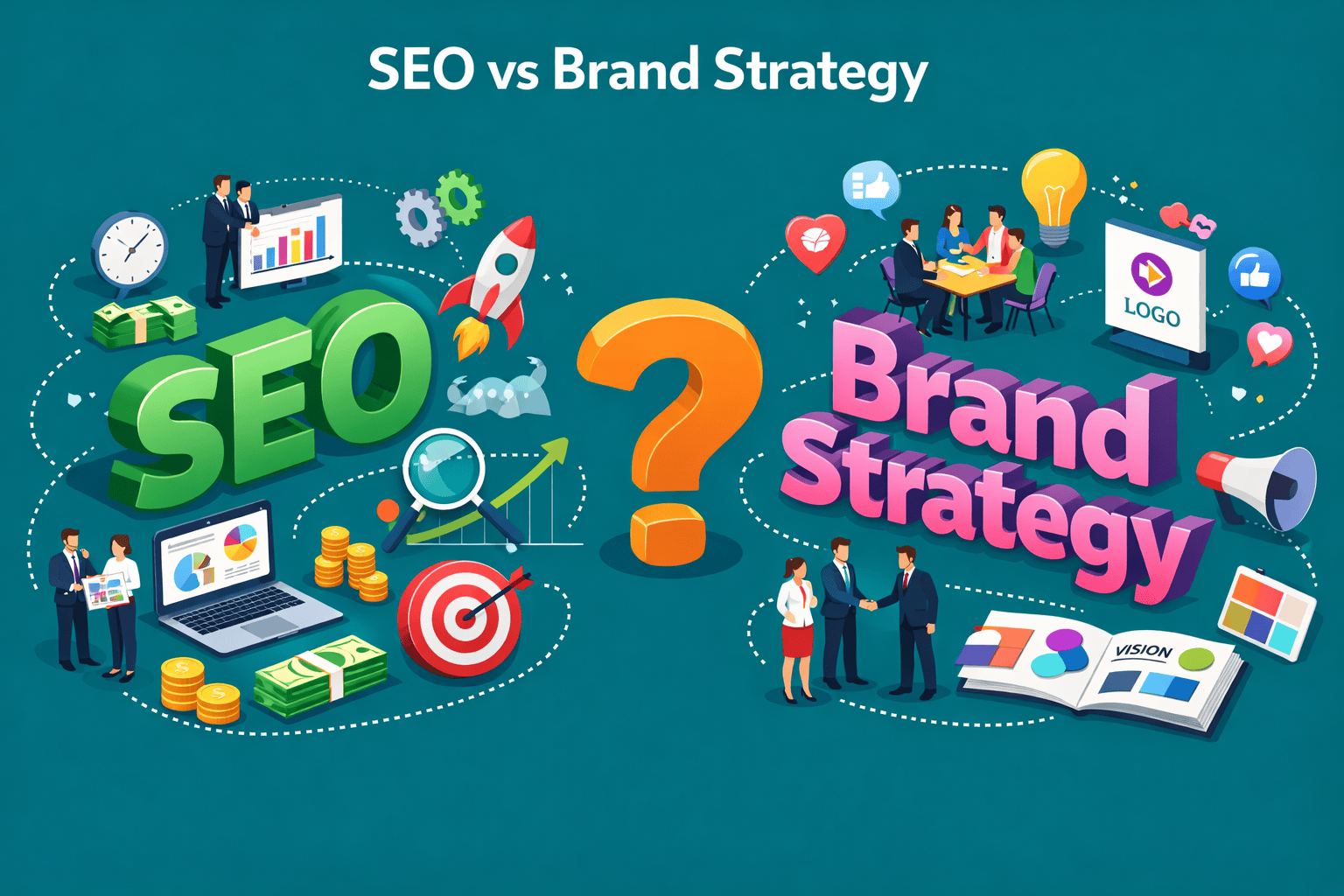
Many businesses today invest heavily in SEO while giving very little attention to brand strategy. They chase rankings, keywords, and traffic numbers, believing that search visibility alone will bring long-term growth. This approach often produces short bursts of results but rarely creates lasting authority.
The debate around SEO vs Brand Strategy has become increasingly important for modern businesses that rely on digital channels for growth. Search engines have evolved significantly, and audiences now expect far more than keyword-optimised pages. They expect trust, consistency, and a clear identity from the companies they interact with online.
Understanding SEO vs Brand Strategy is not about choosing one over the other. It is about recognising how both disciplines work together to build visibility, credibility, and long-term market presence.
Businesses that focus only on SEO often struggle with declining traffic when algorithms change. Companies that focus only on branding often struggle to gain visibility in search engines. The real opportunity lies in balancing both.
In this article, we will explore the real relationship between SEO vs Brand Strategy, why many companies prioritise the wrong one, and how businesses can create a smarter growth system that combines both effectively.
By the end of this guide, you will understand how SEO vs Brand Strategy influences search visibility, customer trust, and long-term business performance.
What is SEO vs Brand Strategy?
SEO vs Brand Strategy refers to the comparison between two essential digital growth disciplines.
Search Engine Optimisation focuses on improving a website’s visibility in search engines, while brand strategy focuses on shaping how people perceive and remember a business.
In simple terms:
- SEO helps people find your business
- Brand Strategy helps people trust and remember your business
Understanding SEO vs Brand Strategy is essential because modern search engines increasingly reward businesses that combine both.
Search platforms such as Google evaluate authority signals beyond keywords. They analyse brand mentions, engagement signals, and trust indicators when determining rankings. According to insights shared on the official Google Search documentation, content quality and credibility now play a critical role in search visibility.
This means that the traditional view of SEO vs Brand Strategy as separate disciplines no longer works.
Instead, businesses need to view them as connected systems.
SEO drives discovery.
Brand strategy builds loyalty.
Together, they create sustainable digital growth.
Why the SEO vs Brand Strategy Debate Exists
The discussion around SEO vs Brand Strategy often arises because many businesses misunderstand what branding actually means.
Most companies treat branding as a visual project rather than a strategic system.
They focus on:
- Logos
- Colour palettes
- Fonts
- Website design
While these elements matter, they represent only the surface layer of branding.
Brand strategy goes deeper. It defines how a company communicates its purpose, values, and positioning.
When businesses misunderstand branding, they often prioritise SEO because it appears more measurable. Rankings, traffic numbers, and keyword reports feel tangible.
However, the deeper truth about SEO vs Brand Strategy is that SEO performance often depends on brand strength.
For example, marketing research tools such as Ahrefs regularly highlight how strong brand searches influence ranking performance. When people actively search for a brand name, search engines interpret this behaviour as a trust signal.
This creates a feedback loop where strong brands naturally improve SEO performance.
Understanding this relationship is essential when evaluating SEO vs Brand Strategy decisions.
Reason 1: SEO Produces Traffic, but Branding Creates Trust
One of the most important lessons within the SEO vs Brand Strategy conversation is the difference between visibility and trust.
SEO can bring users to your website. However, traffic alone does not guarantee conversions.
Visitors often arrive on a page, quickly scan the content, and leave if the brand appears unfamiliar or untrustworthy.
Brand strategy addresses this problem.
A strong brand communicates credibility through consistent messaging, positioning, and tone of voice.
For example, when users recognise a brand name in search results, they are far more likely to click that result.
Studies referenced by Moz show that branded search results often achieve higher click-through rates than generic keyword listings.
This means that the SEO vs Brand Strategy debate should not be about traffic alone. It should focus on what happens after someone discovers your website.
A trusted brand increases:
- Click-through rates
- Conversion rates
- Customer retention
- Word of mouth referrals
Without branding, SEO traffic often remains shallow and temporary.
Reason 2: Algorithms Now Reward Brand Authority
Another major reason the SEO vs Brand Strategy debate matters is the evolution of search algorithms.
Search engines are no longer simple keyword-matching systems.
Modern ranking models analyse multiple signals that indicate brand authority.
These include:
- Brand mentions across the web
- Engagement signals
- Content credibility
- User trust indicators
- Backlink quality
Tools like Screaming Frog often help businesses analyse technical SEO factors, but even perfect technical optimisation cannot compensate for weak brand authority.
When discussing SEO vs Brand Strategy, it is important to recognise that search engines now evaluate brands rather than just webpages.
Google’s documentation on helpful content emphasises the importance of expertise, authority, and trust.
These factors are closely tied to brand perception.
A business with strong brand positioning often gains natural backlinks, brand mentions, and repeat search traffic.
These signals strengthen SEO performance over time.
In other words, strong branding often improves SEO automatically.
Reason 3: SEO Alone Creates Short-Term Growth
Many companies invest heavily in SEO campaigns, expecting consistent long-term traffic growth.
However, the reality behind the SEO vs Brand Strategy debate is that SEO results often fluctuate.
Search rankings can change quickly due to algorithm updates or competitive content.
For example, industry experts like Neil Patel frequently discuss how search rankings can shift dramatically when competitors publish stronger content.
Businesses that rely entirely on SEO often experience unstable growth patterns.
Brand strategy creates stability.
When a brand becomes well known within its market, customers begin searching for the company directly.
These branded searches are far more stable than generic keyword traffic.
This is why the SEO vs Brand Strategy discussion often leads to a strategic realisation.
SEO can introduce your brand to new audiences.
Brand strategy ensures those audiences return.
Companies that understand SEO vs Brand Strategy build sustainable growth systems rather than temporary traffic spikes.
Reason 4: Branding Improves Marketing Efficiency
Another important factor in the SEO vs Brand Strategy discussion is marketing efficiency.
Businesses with strong brand identities often spend less money on marketing over time.
Why?
Because recognition reduces the cost of attention.
When people recognise a brand name, they trust it faster.
This reduces the need for aggressive advertising.
According to research frequently shared by HubSpot, companies with strong brand positioning experience higher conversion rates across marketing channels.
This includes:
- Organic search
- Social media
- Email marketing
- Paid advertising
When analysing SEO vs Brand Strategy, it becomes clear that branding strengthens the performance of every marketing activity.
SEO brings visibility.
Brand strategy multiplies the impact of that visibility.
Reason 5: Brand Strategy Shapes Long-Term Market Position
Perhaps the most important insight in the SEO vs Brand Strategy debate is long-term positioning.
SEO tactics evolve constantly.
Keyword strategies change.
Search behaviour evolves.
Algorithms update.
Brand strategy, however, defines a company’s long-term identity.
It answers critical questions such as:
- Who is this company for?
- What value does it deliver?
- Why should people trust it?
- How is it different from competitors?
Businesses that answer these questions clearly build lasting market authority.
For example, marketing platforms like ShoutMeLoud often discuss how consistent messaging helps companies establish expertise within their niche.
In the SEO vs Brand Strategy discussion, this clarity becomes a competitive advantage.
When a company owns a clear market position, its content naturally becomes easier to rank.
Search engines recognise relevance.
Audiences recognise authority.
Both factors reinforce each other.
How to Balance SEO vs Brand Strategy
The most effective way to resolve the SEO vs Brand Strategy debate is to stop treating them as competing priorities. Modern digital growth requires both. SEO helps your business become visible in search results, while brand strategy ensures that the visibility turns into trust, engagement, and long-term loyalty.
Businesses that focus only on SEO often see traffic increase but struggle with conversions. Companies that focus only on branding often build a strong identity but remain difficult to discover online. The real advantage comes from combining both systems into one integrated strategy.
Balancing SEO vs Brand Strategy requires a structured approach that connects brand positioning, content development, technical optimisation, and authority building.
Below are the key components that help businesses align SEO vs Brand Strategy in a practical and sustainable way.
Build a Clear Brand Foundation
Before investing heavily in SEO campaigns, businesses should establish a clear brand foundation. Without this foundation, SEO content often becomes generic and indistinguishable from competitors.
A strong brand foundation answers the fundamental questions that shape how a company communicates and positions itself in the market. It defines what the business stands for and why customers should care.
This foundation typically includes:
- Brand mission – A clear explanation of why the business exists and the problem it aims to solve.
- Audience definition – A detailed understanding of the people the brand serves, including their needs, expectations, and challenges.
- Unique positioning – A clear statement that explains how the business differs from competitors.
- Messaging tone – The voice and personality the brand uses when communicating with customers.
- Value proposition – A concise explanation of the specific benefits customers receive from the business.
Without these elements, businesses often produce SEO content that targets keywords but lacks a clear perspective. When a brand foundation is well defined, every piece of content supports a consistent narrative. This consistency improves both brand recognition and SEO performance.
Search engines increasingly reward websites that demonstrate expertise and clarity. When a brand communicates a strong identity across its content, search engines can better understand the relevance and authority of that website.
This is one of the most important connections within the SEO vs Brand Strategy relationship.
Align Content Strategy With Brand Positioning
Content marketing sits directly at the intersection of SEO vs Brand Strategy. It is the space where search visibility and brand authority meet.
Many businesses approach content purely from a keyword perspective. They research search terms, write articles around those keywords, and publish content without considering how it supports the brand’s identity.
While this approach may generate traffic, it rarely builds authority.
A stronger approach involves aligning content strategy with brand positioning. Every article, guide, or resource should serve two purposes at the same time.
First, the content should answer a question that people are searching for online. This supports SEO visibility.
Second, the content should reinforce the brand’s expertise and perspective. This strengthens brand credibility.
For example, instead of publishing generic blog posts, businesses can create educational resources that demonstrate deep knowledge of their industry. Detailed guides, strategic insights, and case studies often perform well in search while also strengthening brand authority.
Content formats that work particularly well in the SEO vs brand Strategy balance include:
- Educational blog articles
- Industry analysis
- Research-based insights
- Expert commentary
- Case studies
- Practical guides
When content consistently demonstrates expertise, readers begin to associate the brand with reliable information. Over time, this creates recognition and trust, which improves both engagement and search performance.
Invest in Technical SEO
Brand strategy alone cannot guarantee visibility. Even the strongest brand message requires a technically optimised website to reach search audiences.
Technical SEO ensures that search engines can properly access, crawl, and interpret your website content.
In the broader SEO vs brand Strategy discussion, technical SEO acts as the infrastructure that supports visibility.
Key technical improvements often include:
- Faster page speed – Websites that load quickly provide a better user experience and are more likely to rank well in search results.
- Clean site structure – A logical navigation structure helps both users and search engines understand how information is organised.
- Proper metadata – Clear title tags and meta descriptions improve search visibility and click-through rates.
- Mobile optimisation – With most searches now happening on mobile devices, responsive design is essential.
- Structured internal linking – Internal links help search engines understand relationships between pages and distribute authority across the website.
Technical SEO tools such as Screaming Frog can help identify crawl issues, missing metadata, and other technical problems that affect search performance.
However, technical optimisation should support a broader strategy. In the context of SEO vs Brand Strategy, technical SEO provides the structure that allows brand-driven content to perform effectively in search.
Strengthen Authority Signals
Authority signals play a critical role in modern search ranking systems. Search engines evaluate many indicators to determine whether a website represents a credible and trustworthy source.
These signals strongly influence the relationship between SEO vs brand Strategy.
Some of the most important authority signals include:
- High-quality backlinks – Links from reputable websites indicate that other sources trust your content.
- Industry mentions – Being referenced by credible publications strengthens brand visibility and authority.
- Expert content – Content that demonstrates real knowledge and experience often attracts engagement and citations.
- Thought leadership – Publishing original insights helps position the brand as a recognised voice within its industry.
Businesses that consistently publish valuable insights often attract natural backlinks from other websites, journalists, and industry bloggers. These backlinks improve SEO performance while also strengthening brand reputation.
Authority building is one of the strongest examples of how SEO vs brand Strategy work together. A strong brand attracts recognition, and that recognition strengthens search visibility.
Over time, this creates a powerful cycle where brand authority improves SEO performance, and SEO visibility increases brand exposure.
When businesses understand this relationship, they stop viewing SEO vs brand Strategy as separate activities. Instead, they treat them as interconnected parts of a single digital growth system.
How Digital Junkieee Helps Businesses Align SEO and Brand Strategy
Businesses that want to resolve the SEO vs brand Strategy challenge often need structured guidance.
This is where agencies and strategic partners can help.
At Digital Junkieee, the approach focuses on building integrated digital ecosystems rather than isolated marketing tactics.
Instead of focusing only on rankings, the strategy combines:
- Brand positioning
- Content strategy
- Technical SEO
- Conversion optimisation
Companies interested in seeing how these strategies are implemented can explore the Digital Junkieee portfolio to review previous projects and brand transformations.
For businesses that want to develop stronger digital positioning, the Digital Junkieee services page outlines strategic services designed to align SEO, branding, and digital growth.
If you are evaluating your own SEO vs brand Strategy approach and want professional guidance, you can also reach out through the Digital Junkieee contact page for consultation.
FAQ
What does SEO vs Brand Strategy mean?
SEO vs Brand Strategy refers to the comparison between search engine optimisation and long-term brand positioning. SEO focuses on improving visibility in search engines, while brand strategy focuses on shaping how customers perceive and trust a company.
The most successful businesses combine both approaches to build sustainable digital growth.
Is SEO more important than brand strategy?
The SEO vs Brand Strategy discussion should not be framed as a competition. Both disciplines serve different roles. SEO helps users discover a business, while brand strategy helps build trust and recognition.
Companies that integrate both often achieve stronger and more stable growth.
Can a business grow using SEO alone?
A business can gain traffic using SEO alone, but long-term success usually requires brand development.
In the SEO vs brand Strategy debate, branding strengthens conversion rates, customer loyalty, and market authority.
Without branding, SEO traffic may not convert into lasting customer relationships.
Does branding help SEO rankings?
Yes. Strong branding can improve SEO performance.
In the SEO vs brand Strategy relationship, search engines analyse signals such as brand mentions, engagement, and direct searches. These indicators suggest that a brand is trusted and recognised within its market.
As a result, strong brands often experience better ranking stability.
Final Conclusion
The debate around SEO vs Brand Strategy often begins with the wrong question.
Businesses should not ask which one matters more. They should ask how both can work together to create sustainable growth.
SEO brings visibility. Brand strategy builds trust.
When businesses rely only on SEO, they often experience unstable traffic patterns and weak customer loyalty. When companies focus only on branding without search visibility, they struggle to reach new audiences.
The most effective digital strategies combine both disciplines.
A clear brand identity strengthens every piece of content, while strong SEO ensures that content reaches the right audience.
For organisations that want to build a stronger digital presence, aligning SEO vs Brand Strategy is one of the most powerful steps toward long-term growth.
If you are ready to develop a more strategic digital foundation, explore the solutions available on the Digital Junkieee services page, review real projects in the portfolio, or connect directly through the contact page to begin building a stronger brand and search presence.
0 Comments